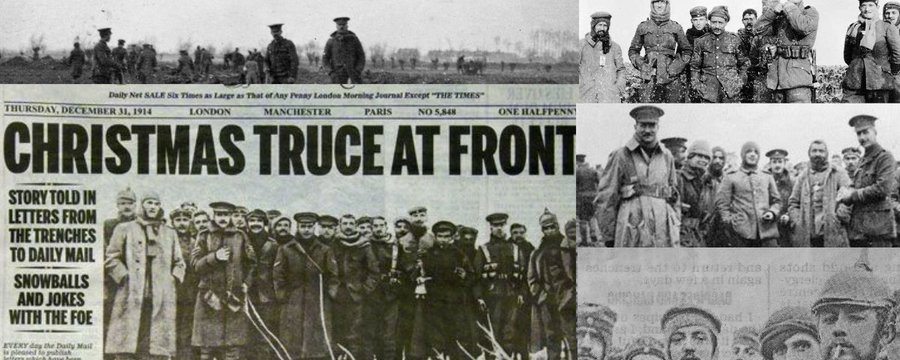
Christmas in the trenches! It must have been sad, do you say? Well, I am not sorry to have spent it there, and the recollection of it will ever be one of imperishable beauty. — Translated letter from an anonymous Belgian soldier, published in the Dublin Evening News, 4th January 1915
The Christmas Day Truce of 1914 reads like the stuff of Hollywood legend, often romanticised and exaggerated. The very notion that bands of men who sought to kill each other hours earlier came together and conversed freely is the height of absurdity — but it actually happened. Private diaries and letters home bear testimony to its legitimacy and the profound effect it had on the men who participated.
Unofficial truces spontaneously occurred in pockets of the Western Front, while in neighbouring areas the business of war continued unabated. Some lasted for just a few precious hours, others for days and even weeks. A desire existed among beleaguered men, beaten down by the fury of an unrelenting Belgian winter and forced to endure atrocious conditions, to commemorate the Christmas season. Practical considerations also played a part — weary battalions wanted to safely bury their dead comrades and make repairs to their defences. It was also a rare and welcome opportunity to rest and recuperate.
Lice, rats, barbed wire, fleas, shells, bombs, underground caves, corpses, blood, liquor, mice, cats, artillery, filth, bullets, mortars, fire, steel: that's what war is. It is the work of the devil. — Otto Dix, German Expressionist Artist
Christmas Came to Flanders Fields
For many, on a frosty Christmas Eve, the guns fell silent. Christmas trees were lit up as songs and carols were sung from trenches on opposing sides of No Man's Land. Cheering and applause rang out amidst scenes of much merriment. Christmas had come to Flanders fields.
Brave armies of disgruntled men poured onto the rugged plains of No Man's Land to stand face to face with their foes. Craving normality and revelling in their newfound sense of sweet liberation, they chatted away, exchanging souvenirs and posing for photos together. The future was riddled with uncertainty and reeked of fear — but for those sacred moments, peace and decency reigned across the blood-soaked fields of Flanders. Armies were conditioned to hate the enemy, but empathy existed amongst young men sharing the same ungodly nightmare.
We spent the morning burying the dead killed in the battle of the 19th, as we had not previously been able to. Some of them were nasty sights, I can tell you, and for the first time I saw what a human body looks like when it is half blown away. I felt quite sick for some time after it, but it is good for us to try and get used to it, as we shall no doubt see plenty more. But if some of the glib talkers could have come and looked at that field strewn with corpses they would talk less airily about wars. I tell you it made me feel what an awful crime against humanity war is. — Capt. John Robert Somers-Smith, 5th City of London Bn, London Rifle Brigade
The Football Match
There has been much written about a Christmas Day football match that took place in No Man's Land, but it's unlikely a definitive, well-organised match took place. However, there are numerous accounts of men taking part in casual kickabouts involving helmets and tunics among other things as makeshift goalposts. Heavy boots and clumpy bomb-ravaged land doesn't lend itself to ideal playing conditions, but spontaneous games broke out nevertheless.
We paid each other visits at the halfway line and exchanged Christmas gifts and buried the dead. Tomorrow we shall continue the old game of killing as the truce cannot last forever. — Private Joshua Kelsall, 3rd Battalion, Rifle Brigade
The Aftermath
These truces were unsanctioned, and ensuing reports of them garnered great anger from military hierarchies. Measures were adopted to ensure there would be no repeat — and sadly, on such a great scale, there never was. This act of defiance never led to lasting peace; fighting resumed within days across the Western Front and continued for a number of years.
The significance of the Christmas Truce should not be underestimated, or its legacy diminished. It stands proudly as a great source of hope and inspiration in a world that forever grows more volatile. One can never comprehend their suffering or how it felt for those souls to pick up their rifles following that Christmas and take aim at enemies now regarded as friends.
The 1914 WW1 Christmas Day Truce is rightly revered, and should always be remembered as a remarkable act of humanity.