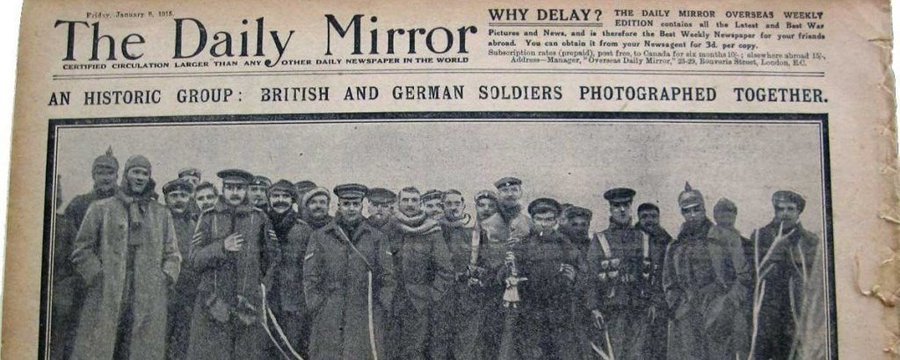
It is estimated that approximately 100,000 soldiers took part in unofficial truces, with spontaneous gatherings occurring mainly in British-held areas across the Western Front. Below is a timeline detailing the events that transpired during and leading up to this momentous event in 1914.
Practical considerations — such as the need to rest and rejuvenate, repair defensive lines and bury the dead — mingled with an overriding desire amongst men on both sides to commemorate the Christmas season.
Early November 1914 Onwards
Localised truces and "live and let live" arrangements occurred in some sectors after a series of manoeuvres ended and battalions bedded into trenches for the winter, following the Race to the Sea and First Battle of Ypres.
December 7th
Pope Benedict XV makes an impassioned plea for an official Christmas truce, but the proposal is swiftly rejected by all sides.
December 11th
The first documented truce takes place involving soldiers from the 2nd Essex Regiment openly fraternising with men from the 19th Saxon Corps in No Man's Land.
December 14th–22nd
British and Indian soldiers engage in a series of brutal battles across a wide section of the Front in support of the French. These included the attack on Wytschaete (14th) and the very bloody defence of Givenchy (20th–21st). The Messines Ridge area also witnesses intense and prolonged fighting in the run-up to Christmas.
December 23rd
German Emperor Wilhelm II sends Christmas trees and gifts to the front to boost morale. German soldiers begin decorating their trenches with small candle-lit trees and placing them on parapets — visible to the opposing lines. This act, though unofficial and sometimes against orders, highlights the determination of soldiers to commemorate the festive season.
Christmas Eve
There is a dramatic shift in weather as the ferocious Belgian rain finally relents and temperatures drop below freezing, giving way to a still and scenic frosty moonlit night. The guns fall silent in many sectors as German troops light candles on trees, hang lanterns, and begin singing Christmas carols — "Stille Nacht" / "Silent Night". British (and some French) soldiers respond in kind by singing their own songs.
It was a beautiful moonlit night, frost on the ground, white almost everywhere; and about seven or eight in the evening there was a lot of commotion in the German trenches and there were these lights — I don't know what they were. And then they sang 'Silent Night' — 'Stille Nacht'. I shall never forget it, it was one of the highlights of my life. I thought, what a beautiful tune. — Private Albert Moren, Second Queen's Regiment
First the Germans would sing one of their carols and then we would sing one of ours, until when we started up 'O Come, All Ye Faithful' the Germans immediately joined in singing the same hymn to the Latin words Adeste Fideles. And I thought, well, this is really a most extraordinary thing — two nations both singing the same carol in the middle of a war. — Rifleman Graham Williams, Fifth London Rifle Brigade
Christmas Day
Unofficial truces are arranged in multiple areas across the Western Front. Soldiers take the opportunity to bury the dead who lay stricken in No Man's Land. In many instances joint burial services are respectfully conducted.
It was an extraordinary and most wonderful sight. The Germans formed up on one side, the English on the other, the officers standing in front, every head bared. — Second Lieutenant Arthur Pelham Burn, Sixth Gordon Highlanders
Soldiers meet in the middle of No Man's Land and talk frankly, exchanging souvenirs, posing for photos and even engaging in casual football matches in some areas.
At daylight on Christmas Day we went halfway and met the Germans and exchanged cigars and cigarettes with one another. They seemed a poor lot of boys and men of 40 with beards. One fellow had been employed as a waiter at the Grand Hotel Eastbourne for ten years and said he wished he was back again. — Private Harry Dixon, Royal Warwickshire Regiment
Suddenly a Tommy came with a football, kicking already and making fun, and then began a football match. We marked the goals with our caps. Teams were quickly established for a match on the frozen mud, and the Fritzes beat the Tommies 3-2. — Lieutenant Johannes Niemann, 133rd Saxons Infantry Regiment
While many lower ranked soldiers revelled in the joviality, there were some who did not agree with their actions.
Such things should not happen in wartime. Have you Germans no sense of honour left at all? — Corporal Adolf Hitler, 16th Bavarians
Boxing Day
Sadly the Christmas Truce was never going to be anything but a gloriously fleeting moment in time. With the rare exception of a few localised areas where peace lasted until New Year and even beyond, the business of waging war resumed.
I fired three shots into the air and put up a flag with 'Merry Christmas' on it on the parapet. He put up a sheet with 'Thank You' on it, and the German captain appeared on the parapet. We both bowed and saluted and got down into our respective trenches, and he fired two shots into the air, and the war was on again. — Captain Charles "Buffalo Bill" Stockwell, Second Royal Welch Fusiliers
The Great War continued for almost four more years and subsequent Christmases saw no repeat of the truce on such a grand scale. I'll leave you with this powerful quote credited to an anonymous Belgian soldier, published in the Dublin Evening News on the 4th of January 1915.
Christmas in the trenches! It must have been sad, do you say? Well, I am not sorry to have spent it there, and the recollection of it will ever be one of imperishable beauty. — Anonymous Belgian soldier, Dublin Evening News, 4 January 1915