In 1914, as the first Christmas of World War I approached, the British General Post Office (GPO, now Royal Mail) played a critical role in delivering letters, parcels, and gifts to soldiers on the frontline. This effort was vital for maintaining troop morale at a time when aching hearts and wandering minds faced up to the grim prospect of a very different Christmas to those enjoyed in bygone years.
The Post Office Goes to War
It was a monumental challenge, especially given the GPO had lost vast numbers of staff to the war. Around 11,000 postal employees enlisted initially, and this number swelled to 28,000 by December 1914. They even had their own battalion — the Post Office Rifles — made up entirely from postal workers. In 1914 the British Post Office employed in excess of a quarter of a million people, making it the biggest single employer of labour in the world.
The Post Office Rifles went on to see action at Ypres, the Somme and Passchendaele, and were awarded 145 decorations for gallantry, including a Victoria Cross (VC) awarded to Sgt Alfred Knight of Birmingham for risking his own life to save others — leaving the relative safety of his trench to single-handedly charge a German machine gun post that was pinning a section of his men down. Three other Post Office recruits serving in different battalions — Albert Gill, Henry Kelly and John Hogan — also received the VC.
The London Home Depot
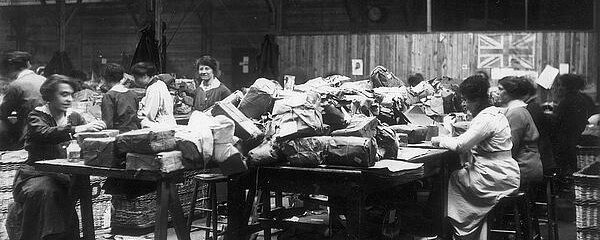
All correspondence bound for the frontline in late 1914 was sorted by the Army Postal Service (APS) at the vast London Home Depot. Located in Regent's Park, this wooden structure spread over five acres and was the biggest of its kind in the world. By 1918 it housed more than 2,500 staff (mainly women) and handled a staggering 2 billion letters and 114 million parcels during the Great War.
The Christmas Rush
Mail to troops surged in the run-up to Christmas. By late 1914, the system handled hundreds of thousands of items daily, growing to peaks of 12 million letters and up to 1 million parcels per week as the war progressed. Christmas 1914 saw extraordinary spikes — 90% more letters and 345% more parcels than normal.
Mail crossed the Channel in huge quantities — over 19,000 mailbags daily at peaks — with risks from U-boats and battlefield conditions. Letters often reached the Western Front in just two days. Parcels and gifts were delivered via base post offices in France (situated in Calais, Le Havre and Boulogne), then forwarded by road or rail to field units. An internal military post system, established in December 1914, also allowed communication between units.
The complex operation was deemed a resounding success and credited with boosting morale by providing a precious link to home and the normality men yearned for. Similar efforts existed in other nations — French and German field post — but the British GPO's scale and efficiency stood out.
What Arrived in Flanders Fields
All manner of treats and small luxuries arrived, from both loved ones and charities — sweets, chocolate, plum puddings, tobacco, warm clothing, and of course the Princess Mary gift box by Royal appointment. The great British public dug deep to ensure that the troops would not be forgotten over the festive period. Some of these gifts would later be shared or exchanged with German counterparts during the momentous Christmas Day Truce that spontaneously occurred in locations across the Western Front.
A Legacy Worth Remembering
UK Post Office buildings now house more than 300 war memorials that pay homage to the 8,500 employees who sadly perished during the Great War, and many more who served and were badly injured. As the UK's primary communication provider (including telephony services), the British Post Office found itself at the epicentre of the war effort. Its immense contribution should never be forgotten.